

MCP server for AI assistants
Let Claude, ChatGPT and other assistants create designed KuikCodes, repoint printed codes and read scan numbers, through the KuikCode MCP server.
The KuikCode MCP server lets an AI assistant work in your workspace the way a teammate would: "make a QR code for our spring menu in our brand colors", "point the lobby code at the new page", "how many scans did the trade-show codes get last week". It speaks the Model Context Protocol, so any assistant that supports MCP connectors can use it.
| Endpoint | https://mcp.kuikcode.com/mcp |
| Transport | Streamable HTTP |
| Sign in | OAuth from the assistant (Claude, ChatGPT), or a KuikCode API key as the bearer token (Claude Code, Cursor and other developer tools) |
| Plan | Business |
Connect from Claude or ChatGPT
- In the assistant, add a custom connector (Claude: Settings, Connectors, Add custom connector; ChatGPT: Settings, Connectors) with the endpoint above.
- The assistant sends you to KuikCode. Sign in if asked, pick the workspace it may use, review the tool list and click Allow. Only workspace owners and admins can connect an assistant, and the workspace has to be on Business.
- Back in the assistant, ask for something. The first request usually takes a few seconds while the design renders.
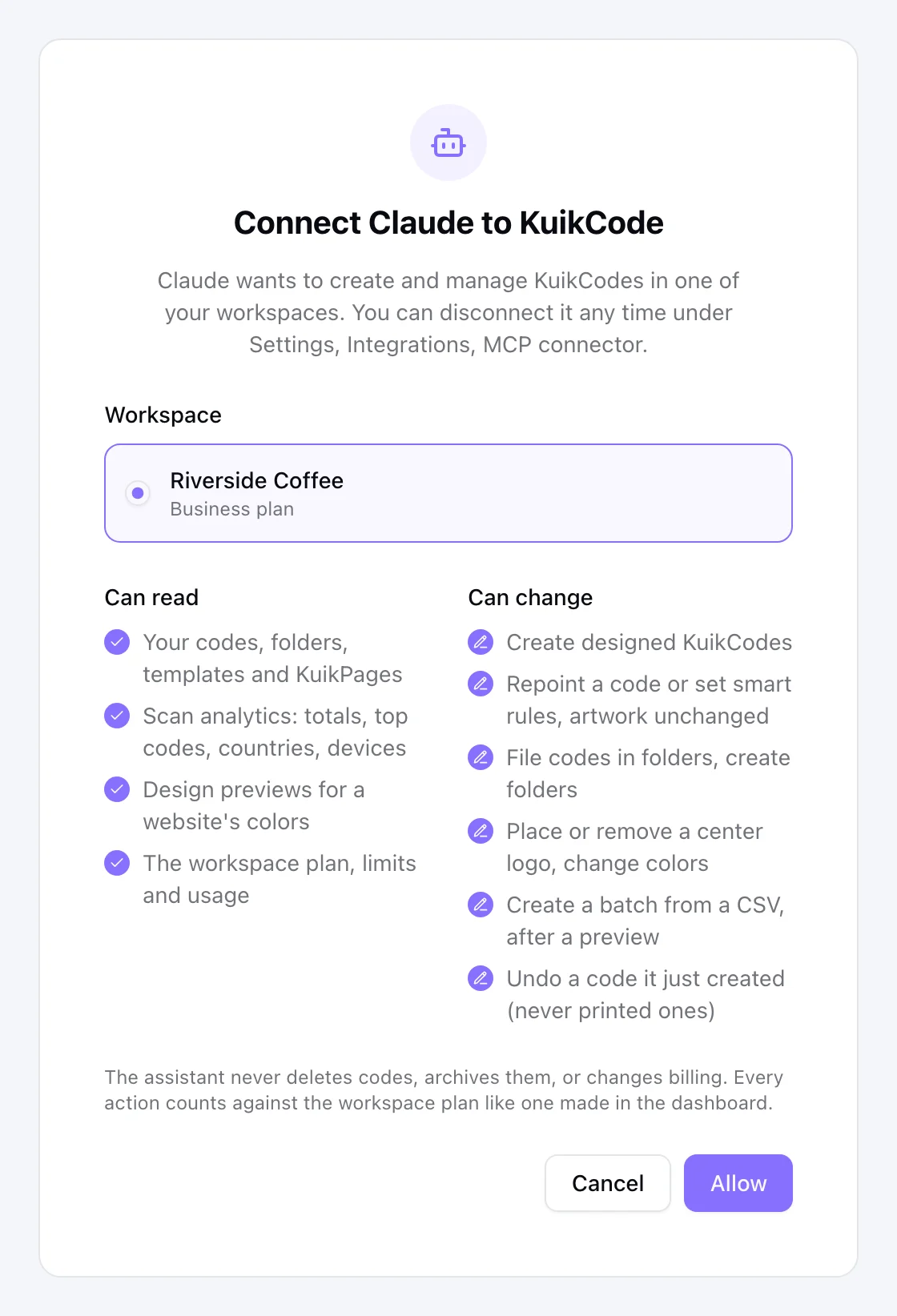
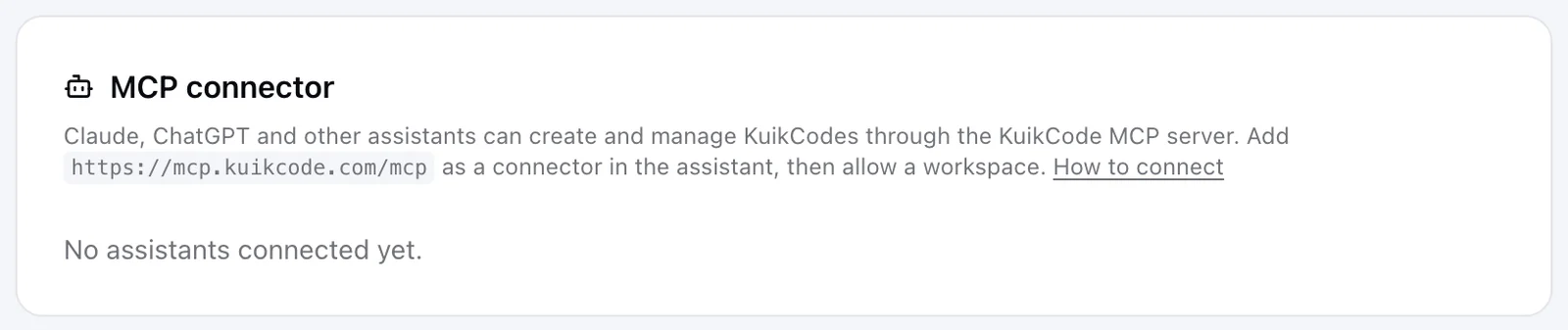
Every connection shows under Settings, Integrations, MCP connector with who connected it and when it was last used. Disconnect ends the assistant's access on its next request; codes it created stay.
Connect with an API key
Developer tools that take a bearer token can skip the consent screen. Create a read and write key under Settings, Developers and configure the server with Authorization: Bearer kc_live_.... For Claude Code:
claude mcp add --transport http kuikcode https://mcp.kuikcode.com/mcp \
  --header "Authorization: Bearer kc_live_..."
The key's own budget and scope apply. A read-only key can list and read but not create.
Things to say
The assistant works from plain requests. A few that map to what the server can do, with what happens next:
| You say | What happens |
|---|---|
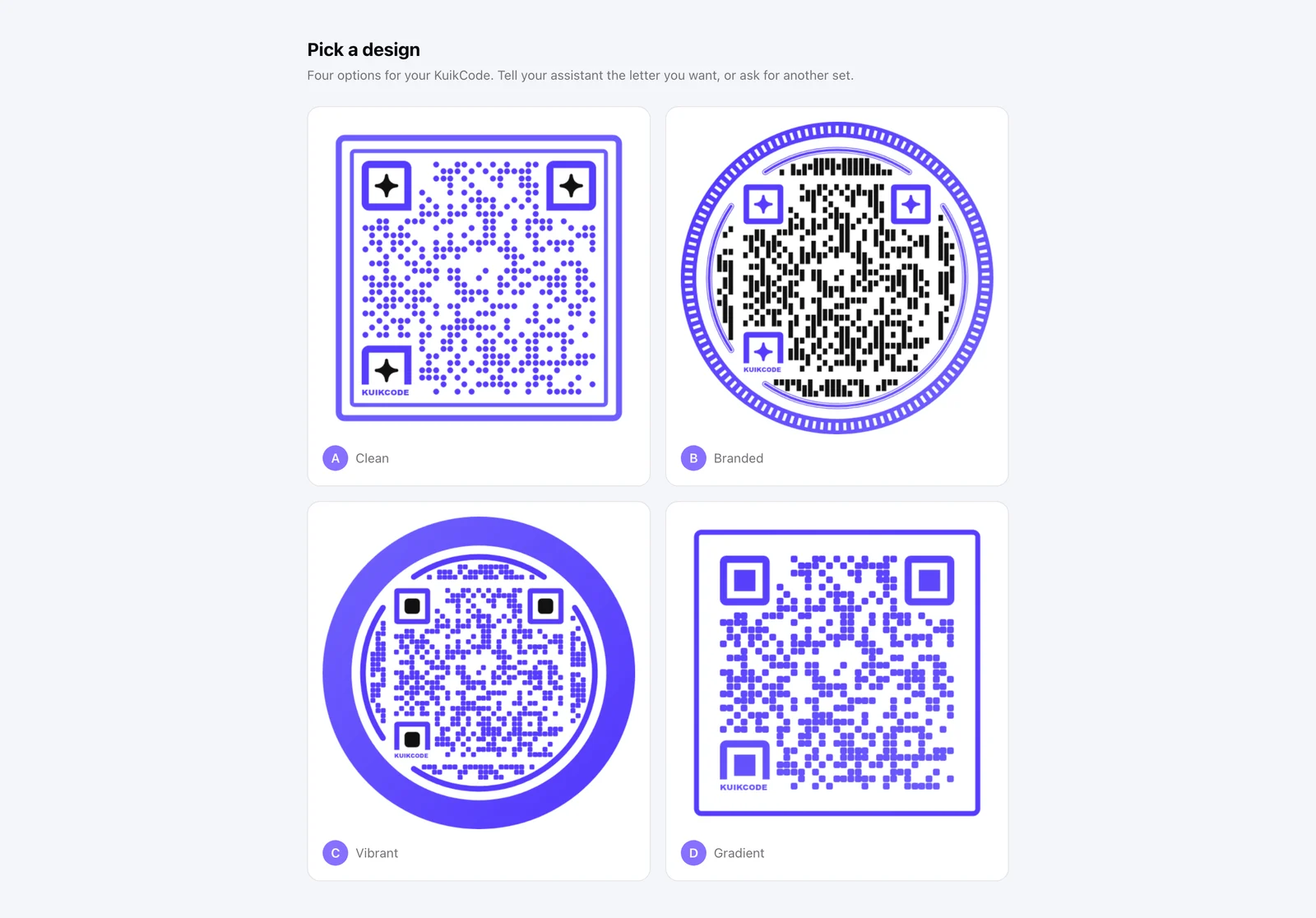
| "Make a QR code for https://example.com/menu in the site's colors" | It proposes a name, reads the site's brand colors and sends you a link showing four designed options, A to D. Nothing is saved until you pick one. |
| "Show me another set" | Four new options for the same colors, new link. |
| "B, but use #456566 and #f59e0b" | Option B recolored with your two colors, same layout, shown before saving. |
| "Use the Fall campaign template" | Saves a code from that saved template at once. Add colors to recolor it. |
| "Plain black and white, call it Lobby poster" | Saves a plain code with that name, no options step. |
| "Put our logo in the middle" (with an image or a URL) | Places the logo in the center and re-renders the artwork. |
| "SVG please" after a save | A download link to the print file. PNG, SVG or JPG, up to 4096 px. |
| "List my codes in the Spring folder" | Names, destinations, scans and a thumbnail link per code. |
| "Point the lobby code at https://example.com/winter" | Repoints the printed code; the artwork never changes. |
| "iPhones to the App Store, Android to Play, everyone else to the site" | Turns it into smart rules, reads them back as sentences, saves on your confirm. |
| "How many scans did the trade-show codes get last week?" | Totals, top codes, countries and devices for that folder and window. |
| "Here is a CSV, one code per row, in our brand colors" | A preview first: rows understood, problems by line, quota impact. The batch is created only after you confirm. |
| "Don't save it" or "undo that" | Before a pick nothing exists; after a save it removes a code created in the last day with zero scans. Anything else is archived from the dashboard. |
Designed codes are never saved sight unseen. The assistant sends a link to a page with the four options, lettered A to D; you answer with a letter and only then is the code created.
What the assistant can do
| Tool | What it does |
|---|---|
workspace_context | Plan, ceilings and usage, so the assistant can explain a limit with numbers |
list_codes, get_code, render_code, download_code | List codes with name, destination and thumbnail, read one, show its artwork, get a download link to the print file (PNG, SVG or JPG) |
list_folders, create_folder, list_templates, list_pages, get_page | Folders (list and create), saved and system templates, KuikPages |
scan_summary, scan_timeseries | Scan totals, top codes, countries and devices; counts over time |
preview_designs | Four designed variants for a website's colors, before creating anything; or one variant shown in your own colors |
create_code | A new dynamic code. The assistant confirms the name and the design source with you first. Designed by default from the destination site's colors: the first call returns four variants to pick from and saves nothing, the second call with your choice creates the code. A template, the Brand Kit, or plain black on white save at once when you ask for them by name. A logo from a URL or the chat goes in the center |
update_destination | Point a printed code somewhere new. The artwork never changes |
set_smart_rules | Route scans by device, country, device language, local time, date, weekday, scan count or location. The assistant reads the rules back as sentences before saving |
move_code | File a code in a folder |
set_logo | Place or remove the center logo, artwork re-rendered |
recolor_code | Swap a saved code's colors for yours, design unchanged (works on template designs too) |
discard_code | Undo a code it just created: only codes under a day old with zero scans; anything else is archived from the dashboard |
create_codes_bulk | A batch from a CSV or rows. The first call is a preview (rows understood, problems by line, quota impact); the batch is created only after you confirm |
The assistant cannot archive codes or delete any code that may be in print, change billing, manage members or edit KuikPages. Everything it does counts against the workspace plan exactly like an action in the dashboard, and shows up in the same places.
Limits and refusals
Tool calls share the workspace's API rate limits. Designed creates and renders are capped at twelve per minute per connection. When a request would pass a plan ceiling, the assistant gets the numbers and a link to Plan & Billing rather than a failure, so it can tell you what to do. Business is the top self-serve plan; for higher ceilings, contact KuikCode about Enterprise.
Privacy
The server stores no data of its own. Each OAuth connection is backed by a hidden API key scoped to the one workspace you allowed; disconnecting deletes its access. Destination URLs, keys and tokens never appear in the server's logs.